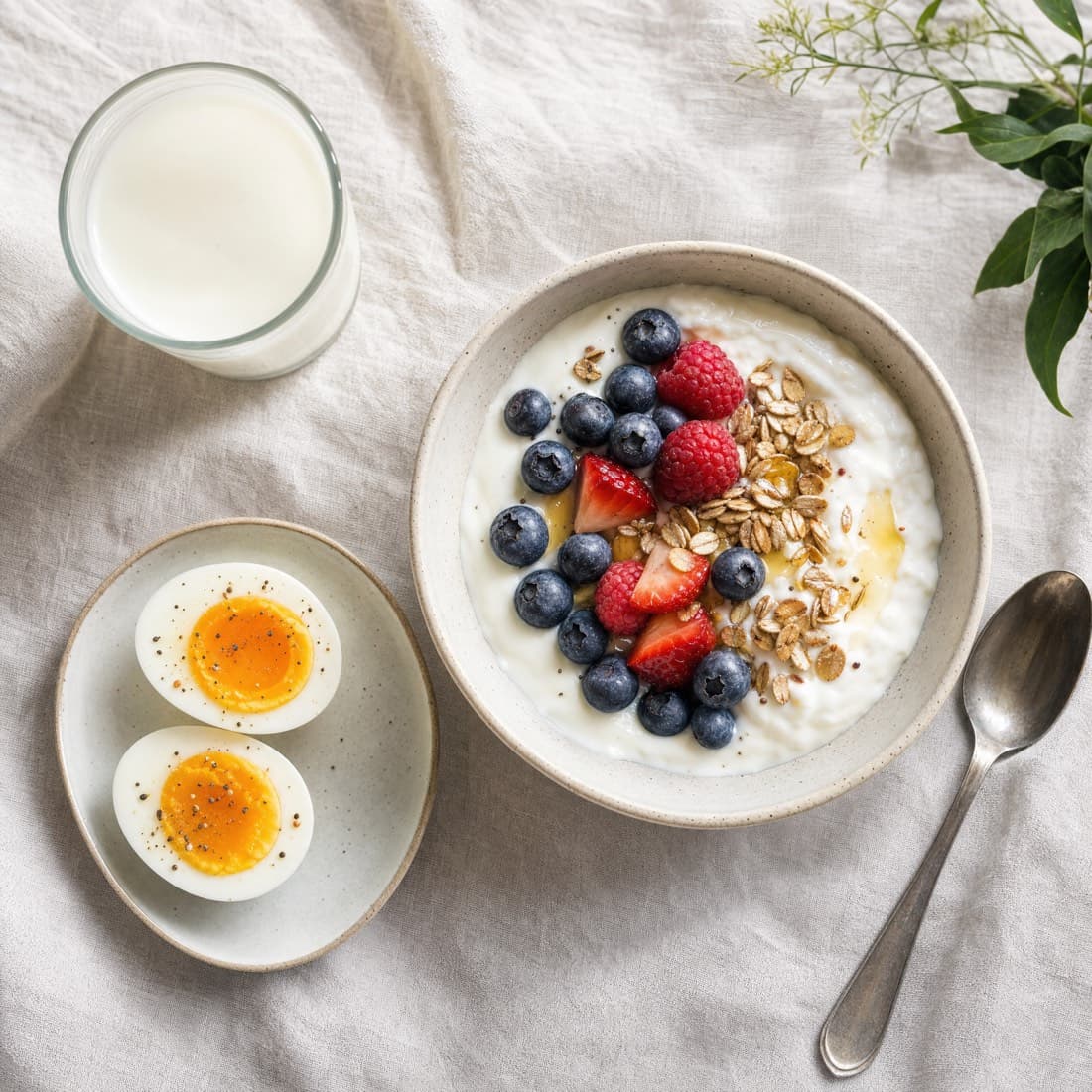
That sentence is most of what you need. The rest of this post is the detail: why eggs punch above their weight, where they genuinely fall short, and how to build them into breakfasts that hold you to lunchtime.
Why do eggs keep you full when toast doesn’t?
Two reasons: protein and volume. Protein digests slowly and blunts the hunger hormone ghrelin harder than carbohydrate or fat does — which is why a 400-calorie egg breakfast and a 400-calorie pastry breakfast produce completely different 11am experiences. If you have read our guide to what protein actually does, eggs are that theory made cheap and practical.
What do the numbers look like?
Notice what the table is really saying: the egg breakfasts are not just lower in calories — they carry two to three times the protein. That is the trade that makes a calorie deficit survivable.
How many eggs a day is reasonable?
For most healthy adults, two to four eggs a day sits comfortably inside current guidance, and dietary cholesterol worries the average person far less than it did in the 1990s — the NHS no longer sets a limit on egg intake for healthy people. If your doctor has told you to watch cholesterol specifically, that conversation wins over any blog post, including this one.
Where do eggs fall short?
- They are not a complete meal. No fibre. Pair them with vegetables, fruit or wholemeal toast, or hunger comes back early.
- The calories are in the cooking. Two eggs fried in a generous knob of butter can double the calorie cost of the eggs themselves. Poach, boil, or use a measured teaspoon of oil.
- Repetition fatigue is real. If you are bored by day ten you will stop. Rotate with yogurt, cottage cheese or leftover dinner protein.
A person weighing 80kg (176lb, or about 12st 8lb) aiming for 1.6g of protein per kilo needs roughly 128g a day. Three eggs cover 18g of it — a strong open, not the whole game.
What should you actually do with this?
Pick one egg breakfast from the table, eat it on your normal weekdays, and let it quietly remove the mid-morning snack you did not really want. Then make sure the rest of your day is built around a protein target you have actually calculated rather than guessed — that number changes everything downstream, and it takes about a minute to get.
Sources
- Halton TL & Hu FB. “The effects of high protein diets on thermogenesis, satiety and weight loss.” Journal of the American College of Nutrition, 2004.
- NHS. “The healthy way to eat eggs.” nhs.uk.
- USDA FoodData Central: whole egg, raw, large — energy and protein per egg.
- British Dietetic Association: protein food fact sheet.